
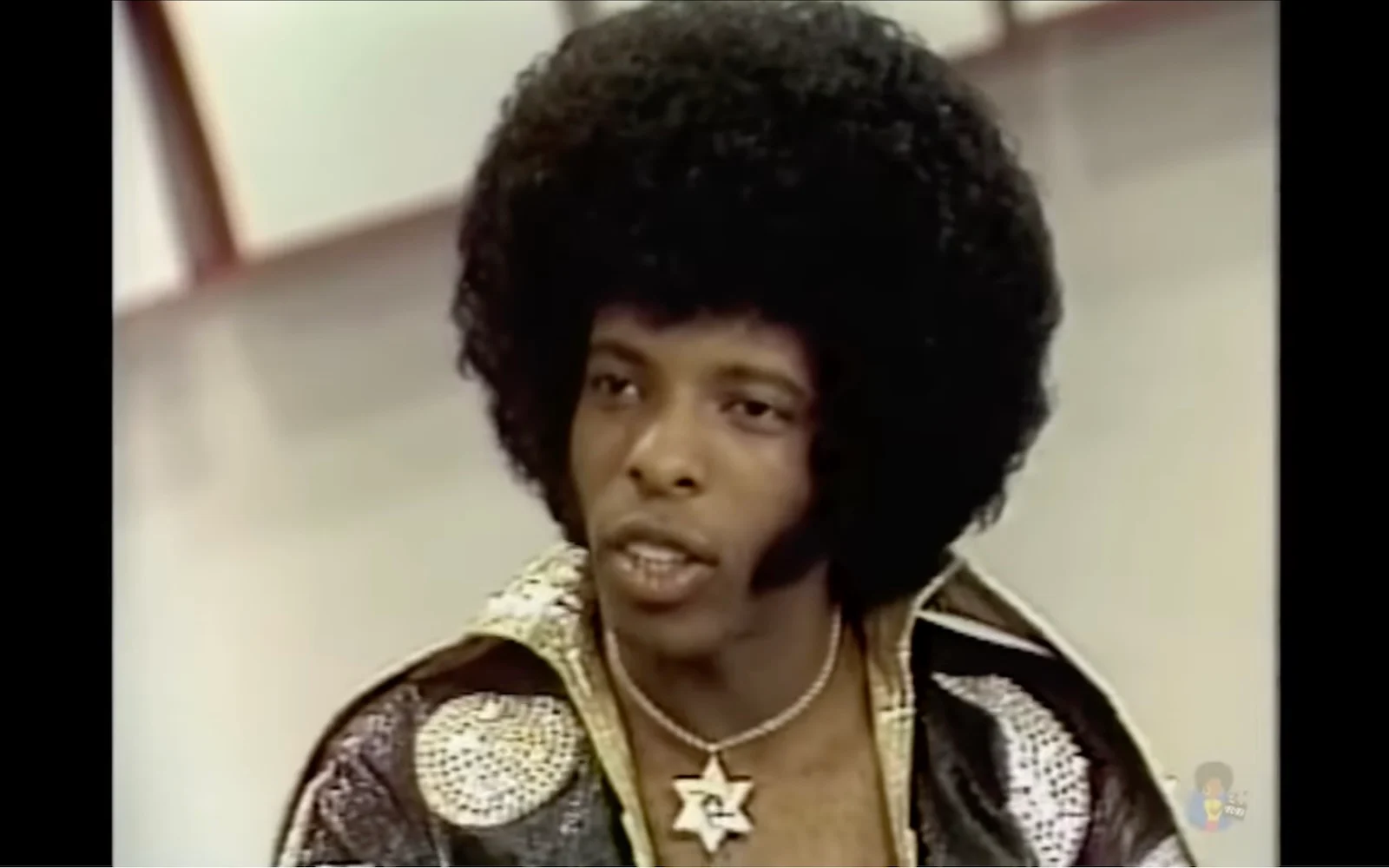
Besides being a musical genius, the late Sly Stone was a fashion icon. His wardrobe consisted of “a psychedelic stew of fringe, rhinestones and lamé that was sometimes celebratory and sometimes chaotic,” according to the New York Times. His flashy accessories included wigs, hats, sunglasses, platform shoes, and jewelry.
One of his favorite pieces of bling was a big, gold Star of David. It was hard to miss the pendant in old photos of him that were published last month, after he died at age 82.
Did Stone, who grew up in a Pentecostal family in Vallejo, California, convert to Judaism as an adult? Did he find “inspiration and meaning in Jewish history and culture,” as this Facebook post asserted without citing a source? Was the necklace a Louis Armstrong-like tribute to some benevolent Jews in his life? A sartorial wink to his song “Everybody Is a Star”?
For an explanation, I reached out this week to Ben Greenman, who co-wrote Stone’s 2023 memoir. (Stone is wearing the necklace in the photo on the cover.) Greenman told me: “He joked about it and shifted his explanation somewhat over the years, but I think where it settled was that it was the Star of David Kapralik.”
Kapralik was Sly and the Family Stone’s manager during the group’s heyday in the late 1960s and early ’70s. A self-described “middle-class Jewish prince” from Plainfield, New Jersey, he worked at Columbia Records and gave Barbra Streisand her first record deal. In 1967, he signed Sly and the Family Stone after seeing them perform in the Bay Area.

Kapralik was as impressed by the band’s multiracial composition as by their funky sound. He was also captivated by their frontman.
“I had, from the get-go, a sense of certainty about him,” he says about Stone (born Sylvester Stewart) in “Sly & the Family Stone: An Oral History” by Joel Selvin. “There was no question that he was a tour de force, that he was an original synthesis that created an original gestalt.”
In the book, Kapralik says he gave the Magen David to Stone. He doesn’t say when or why, but Stone clearly had a thing for stars. He wore pentagrams and hexagrams around his neck and on his costumes. Perhaps he was drawn to the Star of David not as a religious symbol, but as a symbol of his radiance on stage.
Kapralik managed Sly and the Family Stone for about five years — or at least tried to. He and Stone quarreled over money. They insulted each other in the press. They abused drugs. Distraught over the disintegrating relationship, Kapralik attempted suicide.
They parted ways in 1972, but for several years afterward Stone continued to rock his “Star of David Kapralik” necklace in public. He wore it at his over-the-top wedding at Madison Square Garden in 1974. He wore it on “The Mike Douglas Show,” giving his former manager a shout-out on air. And he wore it while performing “What Was I Thinkin’ in My Head” — one of my favorite SATFS jams — on “The Midnight Special.”
As for Kapralik, he left the music business behind, moved to a commune in Boston, took the name Ilili (Hawaiian for, what else, “stone”), and sang children’s songs as part of a duo called HiMe and Ilili. He spent his later years growing flowers and onions on a farm on Maui. He died in 2017.
Michael Rubenstone interviewed Kapralik in 2005 for his documentary “On the Sly: In Search of the Family Stone.”
“There would be no Sly and the Family Stone without David Kapralik,” Rubenstone told me. “You really need someone to champion a new voice, and he certainly did. They represented everything he believed in.”
Kapralik once described Stone as a “golden, luminescent figure of unity … his light was so intense. Searing, that intensity.”
Just like a star.